Muriel Gold’s creative drama curriculum gives educators a process-driven roadmap to turn standard classroom lessons into immersive, experiential learning without requiring stage sets or memorized lines. Developed through decades of artistic leadership and pedagogical research in Montreal, this approach shifts drama out of after-school rehearsals and plants it directly into foundational subjects like language arts, history, and social studies.
Rather than training children to perform for a passive audience, the method uses structured role-play to build emotional intelligence, peer collaboration, and critical analysis. Teachers across Canada frequently discover that the hardest part is not managing student energy, but learning to let go of scripted outcomes.
Why Process Trumps Performance in the Classroom
Traditional school plays prioritize the final product: polished lines, rehearsed cues, and an opening night. In contrast, Gold’s educational drama philosophy treats performance as secondary, focusing entirely on spontaneous discovery and personal reflection.
The essential objective of creative drama is personal growth and conceptual understanding, not the aesthetic approval of an audience outside the circle.
A widespread misconception among non-specialist educators is that classroom drama requires theatrical training, extravagant costumes, or hours of line memorization. Scientific observations in developmental pedagogy demonstrate the opposite: unscripted, guided dramatic play activates deeper cognitive processing because students must think, react, and problem-solve in real time as their characters.
When students step into an imagined circumstance, abstract curriculum guidelines transform into tangible human experiences.
Core Pillars of the Educational Model
The framework relies on clear boundaries and teacher facilitation to ensure spontaneous work remains constructive rather than chaotic. Gold organized dramatic inquiry into targeted exercises that build upon one another, allowing even the quietest learners to participate without public speaking anxiety.
Fictional Role-Play and Subject Integration
By using fictional role-play, educators invite students to examine historical events, literary conflicts, or community issues from the inside out. A history class does not merely read about regional disputes; students step into the roles of townspeople, navigators, or decision-makers navigating those precise pressures.
| Curriculum Component | Classroom Application |
|---|---|
| Sensory Awareness | Non-verbal warm-ups that focus attention and build listening skills before academic tasks. |
| Character Improvisation | Adopting specific social roles to explore historical conflicts or storybook narratives. |
| Tableau & Freeze-Frame | Creating physical snapshots of a scene to dissect power dynamics and underlying themes. |
| Group Reflection | De-roling discussions where students analyze what their characters felt and learned. |
This structured progression ensures that imagination serves an analytical purpose. It also establishes a clear boundary between real-life emotions and fictional scenarios, protecting the classroom environment.
How Educators Put Creative Drama into Practice
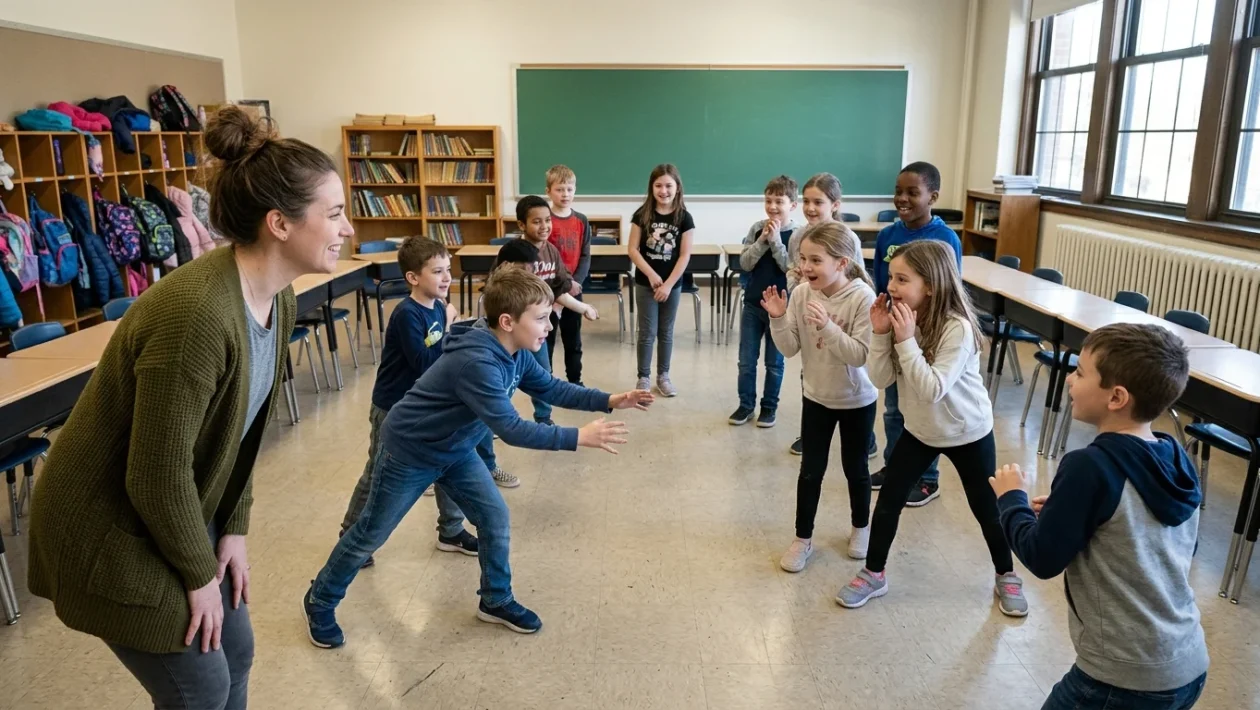
Implementing a creative drama curriculum does not demand a revamped timetable or specialized equipment. Generalist teachers can introduce these principles into existing lesson plans by following a predictable, four-stage sequence:
- Establish a Safe Entry Point: Begin with low-stakes physical exercises, such as silent movement or mirror games, ensuring every student engages without fear of judgment.
- Define the Dramatic Premise: Frame a clear challenge rooted in the subject matter, establishing who the students are, where they are located, and what problem requires a collective resolution.
- Guide from Alongside: Facilitate the action through open-ended prompts rather than directing specific movements, stepping into a supporting role if the narrative needs redirection.
- De-Role and Debrief: Conclude every session with an explicit transition back to the classroom identity, followed by guided questioning to connect the dramatic choices to the academic objective.
By maintaining this consistent rhythm, teachers turn abstract curricular expectations into memorable, lived experiences that foster long-term retention and genuine classroom empathy.
✨ Bringing active drama into ordinary school subjects unlocks creative confidence for students and educators alike.
📱 Share your experience with us on social media or pass this framework along to a colleague looking for fresh classroom ideas.
👇 Leave a comment below detailing how your school approaches creative role-play in daily learning.