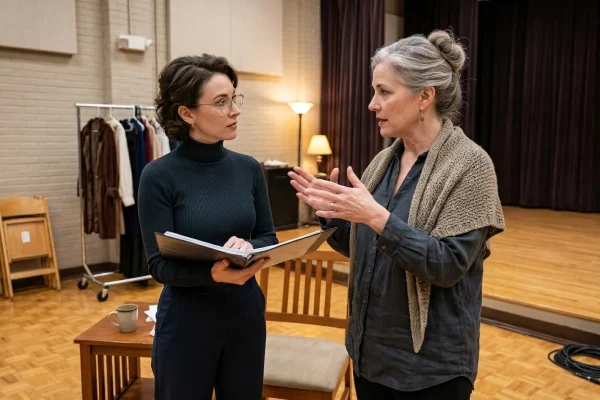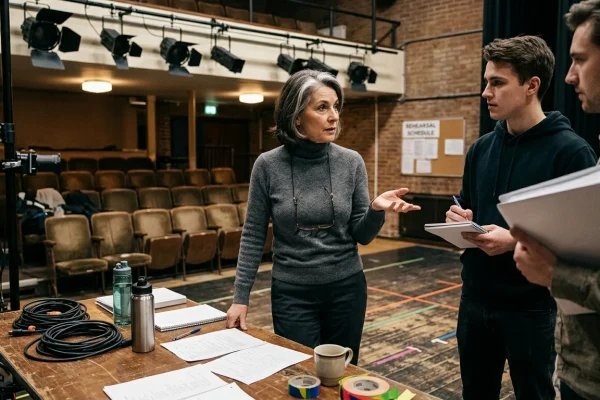

Muriel Gold’s landmark methodology in the thinking director redefines stage leadership by turning traditional rehearsal rooms into collaborative workshops driven by rigorous inquiry and psychological insight. Instead of imposing rigid authority, the Canadian theatre pioneer proved that compelling performances emerge when directors guide actors through deliberate, analytical questioning rather than prescriptive dictates.
For generations of stage artists, the director’s chair was treated as a seat of absolute command. Gold challenged that convention by establishing a structured system that balances textual deconstruction with creative freedom, ensuring that every artistic choice on stage rests on a solid intellectual foundation.
Who Was Muriel Gold and Why Does Her Philosophy Endure?
A distinguished figure in Canadian cultural life and a Member of the Order of Canada, Muriel Gold spent decades shaping the country’s performing arts landscape. As the long-time artistic director of the Montreal Children’s Theatre and an accomplished academic, her work crossed the boundaries between professional stage production and pedagogical theory.
Her central premise with the thinking director was both simple and revolutionary: directing is fundamentally an act of structured cognition. By teaching directors how to formulate better questions rather than deliver quick answers, she transformed the rehearsal hall from a lecture into an investigative laboratory.
True artistic discovery on stage happens when a director resists the urge to provide immediate answers, choosing instead to guide the performer toward discovering the character’s internal logic through purposeful inquiry.
This dynamic permanently shifted how Canadian drama educators and directors approach dramatic texts. Performers trained under this ethos develop durable, repeatable performances because their choices stem from genuine comprehension rather than mimicry.
Deconstructing the Core Elements of the Guide
Gold’s work acts as a practical handbook for dissecting dramatic literature and translating thematic concepts into physical action. It strips away vague artistic jargon in favour of clear, deliberate preparation.
The Shift from Dictation to Inquiry
The traditional model of directing often relied on pre-planned blocking charts and micro-managing vocal inflections. Under Gold’s philosophy, the director acts more like a dramaturgical detective.
The director examines the subtext, social context, and unstated objectives within the script, then frames rehearsal prompts that challenge actors to explore those dimensions organically. This active engagement creates an ensemble culture where performers take real ownership of their roles.
Busting the Myth: Does Analytical Directing Kill Spontaneity?
A pervasive myth in dramatic training claims that excessive intellectual analysis suffocates an actor’s emotional instincts. Detractors often argue that over-thinking a scene results in wooden, detached performances that fail to connect with an audience.
Gold’s framework demonstrates precisely the opposite. Far from dampening instinct, rigorous analysis provides the very framework that allows spontaneous emotion to flourish safely and consistently. When performers fully understand the stakes, psychological obstacles, and emotional architecture of a scene, their intuitive reactions become sharper and far more believable under stage lights.
Core Pillars: Traditional Directing vs. The Thinking Director
Understanding the fundamental distinction between conventional rehearsal leadership and Gold’s analytical approach clarifies why her guide remains a staple in theatre curricula:
| Rehearsal Dimension | The Thinking Director Approach |
|---|---|
| Scene Preparation | Exhaustive textual interrogation and deep subtextual mapping prior to staging. |
| Actor Guidance | Socratic questioning that prompts personal interpretation and organic discovery. |
| Rehearsal Dynamic | Collaborative exploration with room for testing hypotheses and physical choices. |
| Blocking Strategy | Movement derived naturally from inner motivation rather than imposed geometric patterns. |
| Performance Durability | High consistency because choices are grounded in logical character psychology. |
A Step-by-Step Guide to Applying the Method
Directing with this level of intentionality requires a structured workflow before and during rehearsals. Anyone looking to apply the principles of the thinking director can follow this foundational sequence:
- Conduct Exhaustive Textual Research: Read the script repeatedly without blocking in mind, identifying historical context, social stakes, and recurring thematic motifs.
- Map Character Objectives and Obstacles: Chart what each character desires in every beat, identifying the exact psychological roadblocks preventing them from achieving those goals.
- Formulate Diagnostic Questions: Replace directional demands (such as “be angrier here”) with analytical prompts (such as “what is at risk if you back down right now?”).
- Foster an Investigative Space: Allow actors to experiment with alternate motivations during initial read-throughs and early staging sessions to evaluate what feels truthful.
- Refine Physical Expression: Tie every stage movement directly to internal objectives, ensuring no physical action exists merely to fill stage space.
By treating the rehearsal room as an intellectual workshop, stage directors cultivate productions that resonate with clarity, emotional depth, and lasting artistic integrity.
✨ Bringing intellectual rigour to the rehearsal room transforms good scripts into unforgettable stage experiences.
💚 Share your experience with us on how deliberate script analysis has changed your own creative process.
📱 Leave a comment below with your favourite directing techniques or lessons learned from Canadian theatre classics!
👇 Keep the conversation going and share this guide with an indie director or drama student looking for fresh inspiration.