
Muriel Gold books on theatre direction provide Canadian stage practitioners with foundational blueprints for collaborative rehearsals, actor development, and ensemble storytelling. By dissecting the organic interaction between actors and directors, her published literature bridges academic drama theory with practical stage management, establishing rehearsal room techniques that remain central to community and professional productions across the country.
Before Gold documented her rehearsal systems in comprehensive volumes, early Canadian theatre training leaned heavily on rigid European staging models or imported American commercial manuals. Gold challenged that dynamic through decades of hands-on experience, most notably while leading Montreal’s historic Saidye Bronfman Centre Theatre. Her written work turned complex psychological insights into usable exercises for actors, students, and production crews.
Her pedagogical approach demystifies how a production evolves from initial table reads to dynamic blocking under high-pressure performance schedules. That evolution begins with a direct look at the core principles detailed across her essential texts.
Core Methodologies Inside Muriel Gold’s Directing Literature
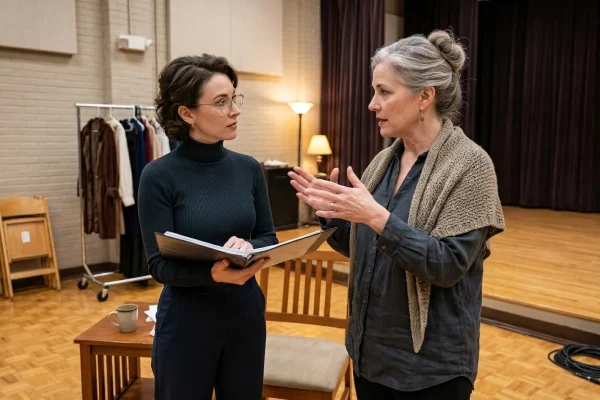
At the heart of Muriel Gold’s instructional texts is the belief that authentic directing requires emotional truth and rigorous structure. Rather than treating directors as absolute authoritarians who dictate every gesture, her books advocate for shared creative ownership between cast and crew. She outlines structured warm-ups, improvisational prompts, and textual interrogation methods designed to help actors locate character motivations independently.
One of her most influential contributions in print is the detailed analysis of rehearsal pacing. Directing a production is not merely about deciding where actors stand; it is about calibrating energetic tempo, spatial tension, and vocal dynamics so that an audience stays fully immersed from the opening cue.
Directing is fundamentally an exercise in deep observation, where the leader shapes emotional truth without imposing artificial mannerisms onto the cast.
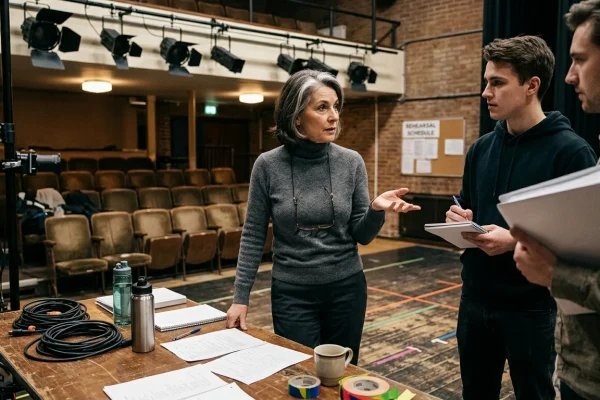
Gold’s writing regularly emphasizes the logistical realities of Canadian regional theatre, offering solutions for directors who must balance tight budgets, brief rehearsal windows, and multifaceted production teams. Her direct guides demystify the collaborative workflow between the director, lighting designers, costumers, and stage managers.
The Fictional Family Technique in Rehearsal
Among her most recognized systems, detailed extensively in her published work, is the concept of the “fictional family.” This technique immerses cast members in structured, improvisational relationships that exist outside the strict lines of the script. Actors develop shared backstories, domestic habits, and subtle interpersonal tensions during off-text exercises.
By establishing these authentic behavioral connections beforehand, the cast enters formal scene work with instinctual chemistry rather than mechanical memorization. The director then guides the scene knowing that the subtext has already been deeply internalized.
Director as Autocrat vs. Collaborative Facilitator: Debunking Stage Myths
A persistent myth in modern theatre claims that an effective director must operate as an unflinching autocrat who holds every aesthetic decision in absolute control. Popular culture often romanticizes the volatile, dictatorial visionary who breaks actors down to achieve dramatic impact.
Gold’s texts dismantle this misconception entirely through practical case studies and production logs. Her writings document that an ensemble produces superior vocal clarity, emotional depth, and consistent performances when the director acts as an active facilitator. Collaborative trust consistently eliminates stage anxiety and reduces interpersonal friction during rigorous production weeks.
Comparing Muriel Gold Directing Principles with Traditional Staging
| Directing Dimension | Muriel Gold Methodology |
|---|---|
| Actor Preparation | Focuses on immersive subtext, group dynamics, and off-text relational exercises. |
| Blocking Strategy | Encourages organic spatial movement emerging from character objectives. |
| Rehearsal Dynamic | Fosters democratic feedback loops and creative actor input under firm guidance. |
| Ensemble Building | Prioritizes mutual vulnerability and ensemble chemistry before formal line polish. |
How to Apply Her Directing Steps to a Community or Regional Production
Aspiring stage directors can integrate Gold’s literary techniques into their rehearsal rooms using a clear, phased approach that strengthens both amateur and seasoned casts:
- Conduct Unscripted Backstory Explorations: Before blocking formal scenes, arrange improvisational sessions where actors interact as their characters in everyday situations not written into the play.
- Map Physical Territory: Establish spatial relationships on stage based on power hierarchies and emotional proximity, allowing movement to reflect psychological subtext naturally.
- Cultivate Open Rehearsal Critiques: Allocate regular five-minute debriefing windows at the end of runs to discuss what felt genuine and where blocking felt restrictive.
- Fine-Tune Sightlines and Acoustic Rhythm: Systematically polish timing, pause lengths, and focal points so the performance translates clearly to every seat in the house.
Applying these steps systematically ensures that a director builds a cohesive performance environment rather than a disjointed collection of individual monologues. The resulting stage craft resonates with audiences across Canadian arts communities by maintaining psychological authenticity from curtain rise to final bows.
✨ Bringing intentional rehearsal methods into your local theatre company transforms the entire creative process.
💚 Share your experience with us on how collaborative directing techniques have impacted your stage productions.
📱 Leave a comment below with your favourite Canadian stage literature and rehearsal room insights.
👇 Keep exploring classic Canadian theatrical traditions and practical directing manuals for your upcoming season.