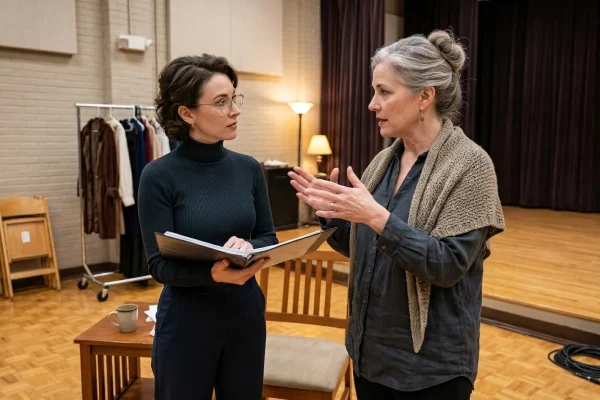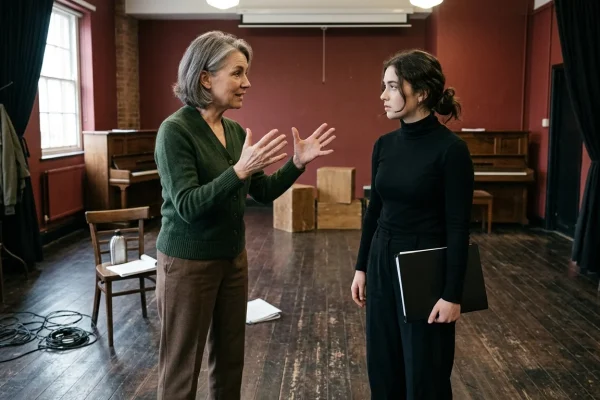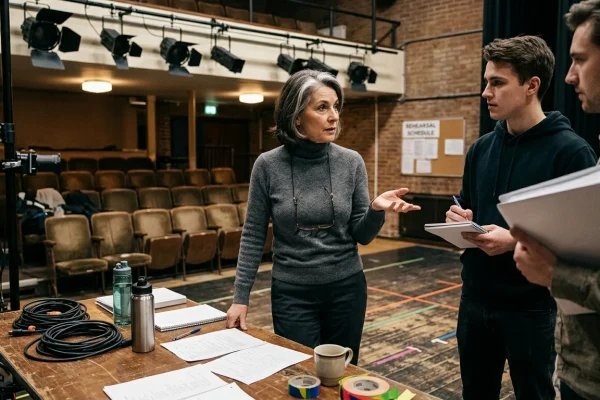
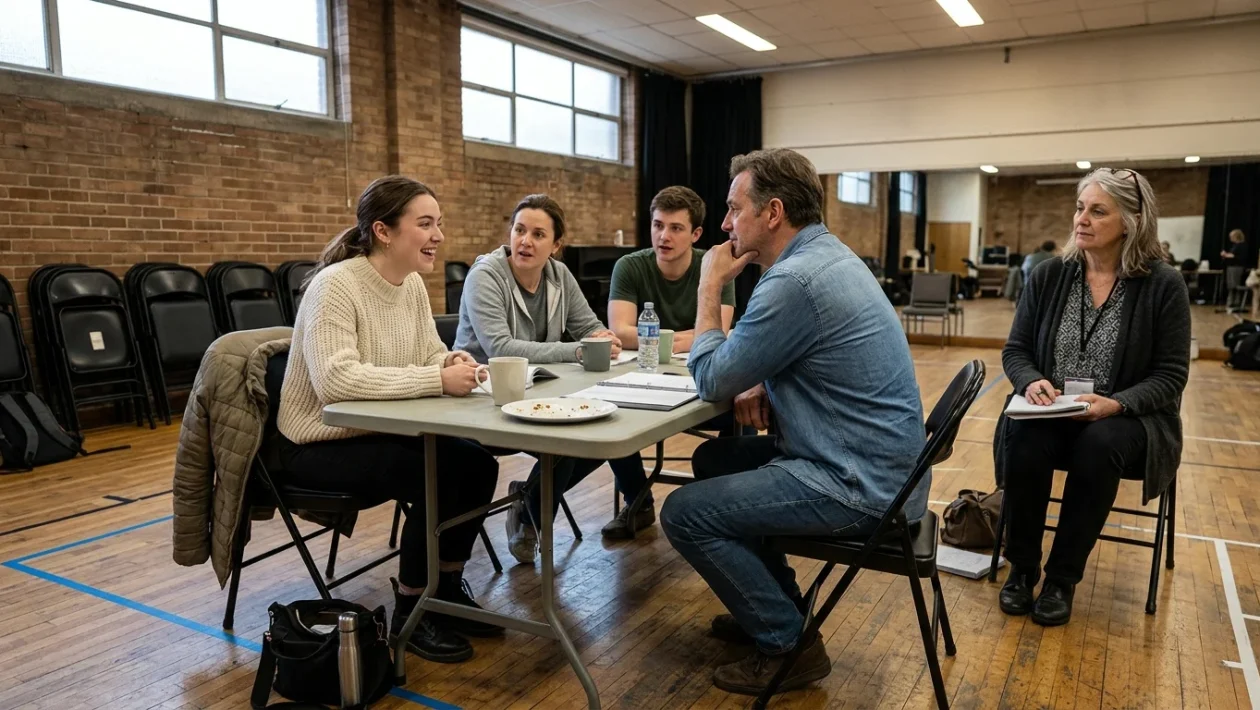
Canadian theatre director and educator Muriel Gold developed the fictional family technique by blending improvisation, ensemble rehearsal exercises, and systemic role play to help actors create rich character subtext without exploiting their own personal trauma. Instead of forcing performers to mine painful private memories on stage, Gold designed an experiential workshop framework where an entire cast collaboratively constructs a shared, multi-generational household from scratch.
Born out of Montreal’s vibrant performing arts scene and university lecture halls, the process fundamentally transformed drama pedagogy across Canada. Performers do not simply read a script and imagine their individual backstory in isolation. They live through fabricated domestic rituals, sibling rivalries, and dining-room conflicts before touching a single line of their official theatrical dialogue.
The breakthrough emerged when Gold observed that traditional character prep often isolated cast members rather than uniting them. Actors would return to rehearsals with private notebooks filled with internal monologues, yet their interactions on stage remained stiff, intellectual, and disjointed.
The Classroom Dilemma That Sparked a Structural Breakthrough
During her tenure leading student companies and community theatre productions in Montreal, including her celebrated work with the Saidye Bronfman Centre Theatre, Gold noticed a recurring roadblock in rehearsals. Young actors understood their characters intellectually, but their physical listening skills and emotional reflexes lacked genuine authenticity.
Conventional North American acting schools frequently leaned on harsh emotional recall techniques popularized by early Method acting teachers. While those exercises could produce tears or rage, they routinely left performers emotionally dysregulated and isolated from their castmates.
True stage presence does not come from isolating an actor inside their own private memories, but from establishing an undeniable, living web of relationships between every player on the floor.
Gold set out to create a laboratory where actors could manufacture authentic, high-stakes emotional memories collectively. By grounding character development in an imagined domestic circle, performers could access intense vulnerability while remaining completely protected by the safety of fiction.
Step-by-Step: How the Fictional Family Technique Works
The brilliance of the fictional family technique lies in its structured progression. It moves performers smoothly from abstract ideas into spontaneous emotional reality through a series of layered exercises:
- Assigning Family Archetypes: The ensemble establishes a core household structure, assigning roles such as parents, siblings, distant cousins, and domestic partners across generations.
- Architectural Mapping: Participants physically sketch and walk through the floor plan of their imaginary home, defining where private conversations occur, where family heirlooms sit, and where domestic boundaries lie.
- Shared History Improvisations: Without a script, the group improvises defining collective memories, such as disastrous holiday dinners, financial crises, or unspoken community scandals.
- Subtext Transfer: The cast transitions directly into the actual rehearsal text, carrying the unscripted history, unspoken resentment, and domestic intimacy into their scripted character interactions.
This deliberate sequence builds an immediate shorthand among actors. When two performers lock eyes on stage during opening night, they share a catalogue of physical memories that informs every pause, touch, and defensive posture.
From Individual Archetype to Collective Subtext
Gold emphasized that a family is an interconnected psychological system rather than a collection of separate personalities. If one member shifts their posture, the entire living room reacts.
Her technique requires participants to track how status moves between rooms and across generations. A character who commands authority in the kitchen might shrink into submission in the formal dining room, establishing complex behavioural patterns that mirror actual human relationships.
Comparing Ensemble Methods
To understand why Gold’s approach gained such wide adoption in drama therapy and professional theatre training, examine how it contrasts with conventional character preparation.
| Traditional Solo Preparation | Gold’s Fictional Family Technique |
|---|---|
| Individual character biography written in isolation | Collaborative family history generated through active improvisation |
| Relies on personal affective memory and private recall | Creates shared, fictionalized memories safely bounded by dramatic play |
| Focuses heavily on internal monologue and solo objectives | Focuses on systemic group dynamics, physical habits, and mutual listening |
| Ensemble chemistry built late during technical run-throughs | Ensemble trust established before rehearsing formal text |
Busting the Method Acting Myth
A widespread misconception in modern acting circles suggests that authentic emotional intensity requires an actor to expose their real-life personal trauma. Many training programs pushed young performers to dredge up private grief to fuel theatrical conflict.
Gold’s work demonstrated that the human nervous system responds with equal visceral honesty to vivid, collective imagination. By establishing clear dramatic safety protocols, the fictional family technique produces raw, tear-streaked dramatic truth without crossing therapeutic boundaries or damaging performer mental health.
When an actor knows their boundaries are safe inside a shared fictional history, their willingness to take massive artistic risks increases exponentially.
Because the drama belongs entirely to the imaginary lineage, actors can explore deep hostility, unconditional warmth, and complex guilt without personal fallout when the rehearsal ends.
Cross-Disciplinary Reach in Canadian Education
While originally developed for stage performers, the method quickly crossed disciplinary lines across Canada. Drama therapists, social workers, and university educators recognized that constructing an imaginary family offered a non-threatening mirror for real-world interpersonal conflict.
High school classrooms and university studios frequently employ Gold’s exercises to build empathy among students from wildly diverse backgrounds. Stepping into a shared domestic structure forces participants to navigate differences in status, values, and communication styles in real time.
By shifting focus from individual ego to ensemble survival, Gold built a repeatable, humane training methodology that continues to shape Canadian arts education and rehearsal halls.
✨ Exploring creative techniques transforms the way we understand human connection both on and off the stage.
🎭 Have you ever used improvisation or collective storytelling to build trust in a creative team?
👇 Leave a comment below and share your thoughts on Muriel Gold’s revolutionary acting framework!