
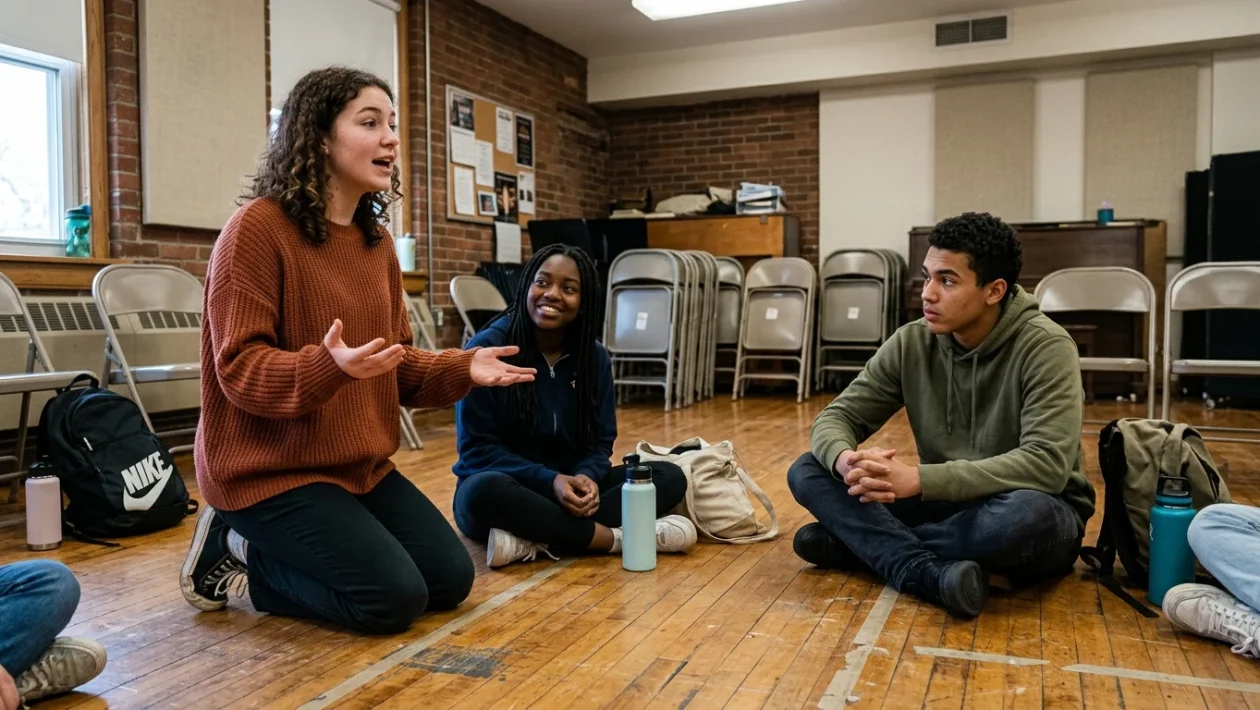
Muriel Gold drama therapy interventions provide adolescents with structured creative role-play frameworks that strengthen emotional regulation, resolve peer conflict, and build interpersonal empathy without putting youth directly on the spot. By stepping into fictional roles rather than dissecting personal trauma head-on, teenagers navigate complex identity challenges with genuine psychological safety.
Adolescence involves rapid neurological changes and intense social pressures, often leaving young people struggling to articulate internal distress. Traditional talk therapy can sometimes feel overly clinical or intimidating to an adolescent who feels defensive or misunderstood. Expressive arts practices bridge that communication gap by transforming abstract anxiety into concrete, manageable creative actions.
The core philosophy developed by Canadian theatre director and drama specialist Dr. Muriel Gold focuses on experiential role-taking. Rather than asking a teen to defend their real-life choices, it invites them to test alternate decisions through protective dramatic framing.
What Is the Fictional Family Technique?
The cornerstone of Gold’s clinical and educational methodology is the Fictional Family technique. In this intervention, participants build an entirely imagined multi-generational family unit from scratch, creating distinct personalities, relationships, histories, and domestic tensions.
Teenagers work collectively to assign character traits, social backgrounds, and interpersonal friction points within this invented household. Because the family is explicitly fictitious, youth feel liberated from the fear of exposing their own private domestic lives.
The therapeutic power of dramatic projection lies in aesthetic distance: when adolescents step into an imagined character, they express authentic inner feelings without feeling exposed or judged.
Once the foundation is set, facilitators introduce realistic external crises or internal disputes that the fictional family must confront. As teenagers improvise through these scenarios, they unconsciously draw upon their own instincts, anxieties, and values to solve the dilemmas.
How Aesthetic Distance Protects the Teenage Brain
In clinical psychology, aesthetic distance refers to the delicate balance between emotional engagement and objective separation. If a therapeutic activity cuts too close to a teenager’s lived trauma, the nervous system triggers a fight-or-flight response, causing emotional shutdown.
Conversely, if an activity feels detached or frivolous, no meaningful therapeutic processing occurs. Gold’s intervention balances directly on this boundary. The adolescent controls the character’s voice, allowing repressed frustration, grief, or ambition to surface safely through the mask of fiction.
Myth vs. Reality: Drama Therapy in Adolescent Mental Health
A widespread misconception assumes that drama therapy is simply an extracurricular acting class or stage performance designed for extroverts. Many assume that youth must possess performance talent or public speaking ambition to benefit from creative interventions.
The clinical reality is entirely different. Drama therapy focuses on internal psychological discovery and relational dynamics rather than theatrical polish, memorized scripts, or audience entertainment.
| Traditional Theatrical Acting | Muriel Gold Drama Therapy |
|---|---|
| Focuses on polished performance, aesthetic skill, and public presentation. | Focuses on emotional processing, personal insight, and self-expression. |
| Follows an external script written by a playwright. | Emerges spontaneously from the participant’s internal psychological landscape. |
| Judged by technical accuracy and audience reception. | Assessed by personal growth, empathy building, and emotional release. |
| Actors adapt themselves to fit an external character design. | Characters serve as protective mirrors for the participant’s lived experience. |
Core Steps in a Youth Drama Therapy Intervention
Facilitators across community centres, clinical practices, and educational environments in Canada utilize structured stages to implement these interventions successfully. Establishing firm physical and emotional boundaries ensures that youth remain grounded throughout the process.
- The Warm-Up and De-Role Preparation: Physical movement, vocal warm-ups, and playful focus exercises ground the teenagers in the room and build mutual group trust.
- Character Construction: Participants collaboratively draft character profiles, detailing fears, habits, motivations, and hidden vulnerabilities.
- Enactment of the Central Dilemma: The group acts out spontaneous scenarios involving school conflict, intergenerational misunderstandings, or social exclusion.
- Structured De-Role Rituals: Youth deliberately step out of their roles through physical actions, such as symbolically shedding an imaginary costume or stating their real names aloud.
- Reflective Group Processing: Facilitators guide a non-judgmental discussion exploring how the characters handled adversity and what real-world parallels surfaced.
The final reflection period represents the moment where true therapeutic integration occurs. Teenagers examine the motivations of opposing characters, realizing that negative behaviours often stem from unexpressed pain or fear.
Why Canadian Youth Mental Health Specialists Value Creative Approaches
Mental health advocates across provinces have increasingly highlighted the necessity of experiential, trauma-informed programming. Adolescents experiencing social marginalization, neurodivergence, or high anxiety often encounter barriers within strictly verbal cognitive therapies.
Dr. Muriel Gold’s work, originating from Montreal’s vibrant educational and theatre communities, demonstrated how structured artistic play serves as preventative community care. The technique cultivates profound active listening skills, teaching teenagers to observe non-verbal communication, tone, and emotional subtext during peer interactions.
Engaging in role-reversal exercises rewires social cognition, allowing a young person to literally inhabit the emotional reality of someone they previously viewed as an adversary.
By stepping into the shoes of parents, teachers, or isolated peers, adolescents expand their emotional toolkit. They develop resilient coping strategies that translate directly into their classrooms, families, and everyday social lives.
✨ Creative therapeutic approaches offer adolescents transformative tools to understand themselves and their peers on a deeper level.
💚 Share your thoughts in the comments below about how creative arts and expressive therapies have impacted youth in your community.
📱 Pass this article along to educators, therapists, and parents looking for engaging ways to support adolescent well-being.
👇 Let us know your perspective and join the discussion today.