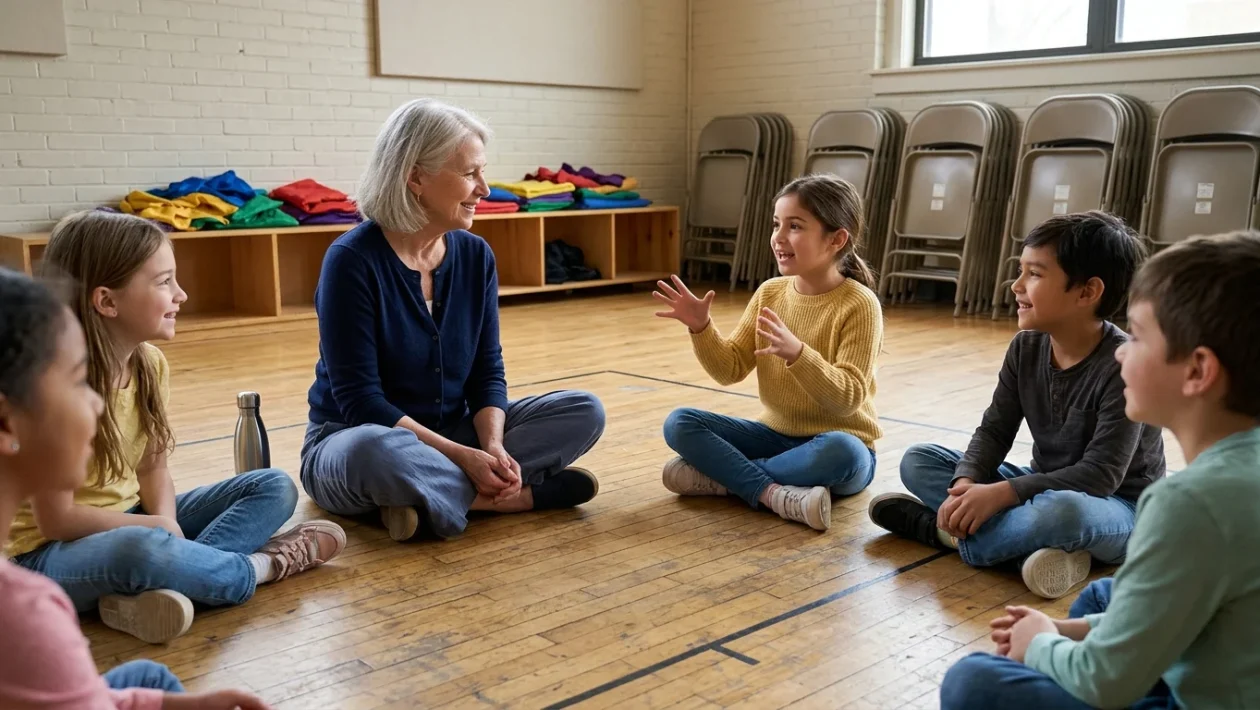
Muriel Gold’s pioneering blueprint for creative drama for children shifts the spotlight away from rehearsed scripts and stage fright, directing it entirely toward spontaneous self-expression, cognitive empathy, and collaborative play. Rather than training young people to deliver adult-written lines to an audience, this approach treats theatre as an experiential learning laboratory where personal growth takes precedence over performance polish.
Across Canadian classrooms and community arts centres, educators have long sought alternatives to high-stress performance models. Gold, an accomplished Montreal director, educator, and Member of the Order of Canada, systematically demonstrated that dramatic play functions best as an internal voyage of discovery. The core mechanism is remarkably direct: by stepping into imaginary roles, children test real-world emotions, dismantle social anxieties, and resolve conflicts inside a completely safe environment.
Yet understanding how unscripted dramatic play produces measurable confidence requires looking closely at how process-based theatre actually operates when the pressure of a final curtain call is removed entirely.
What Sets Creative Drama Apart From Traditional Youth Theatre?
The fundamental distinction between performance theatre and creative drama centres on the target audience. In conventional children’s theatre, young actors memorize cues, hit physical stage marks, and repeat scenes to entertain spectators sitting in the dark. In contrast, creative drama for children has no outside audience whatsoever; the participants are their own spectators and creators simultaneously.
Traditional theatre asks a child to reproduce someone else’s finished idea, whereas process-oriented drama asks the child to navigate an authentic problem from the inside out.
This subtle shift fundamentally alters childhood brain engagement. When young learners are freed from the fear of forgetting lines or making mistakes in front of parents, their nervous systems relax. The play becomes an uninhibited arena where cognitive problem-solving unfolds in real time.
| Traditional Children’s Theatre | Muriel Gold Creative Drama |
|---|---|
| Script-driven with fixed dialogue | Improvisational and spontaneous dialogue |
| Product-oriented (the opening night performance) | Process-oriented (personal and social growth) |
| Directed top-down by an adult | Facilitated collaboratively with participants |
| Focuses on external vocal projection and blocking | Focuses on internal empathy and emotional literacy |
| Judged by an external audience | Evaluated through self-reflection and group debriefing |
Because the work relies entirely on genuine peer interaction rather than pre-planned theatrical cues, educators often encounter surprising shifts in classroom dynamics.
The Core Pillars of Muriel Gold’s Drama Education Philosophy
Gold’s educational work, including her recognized integration of fictional family structures and character studies, introduced structured techniques that keep open-ended play grounded and constructive. Rather than allowing drama sessions to dissolve into chaotic recess games, her methodology establishes purposeful boundaries that channel creative energy.
Sensory Awareness and Physical Imagination
Long before tackling complex narrative roleplay, participants engage in exercises designed to sharpen sensory perception. Children explore how to communicate weight, texture, weather, and distance using only physical posture and breath. This somatic grounding anchors attention and helps energetic children channel physical restlessness into focused dramatic presence.
Emotional Literacy and the Fictional Family
One of Gold’s defining pedagogical contributions involved immersing groups in long-term roleplay frameworks, such as a constructed “fictional family.” Within these ongoing simulations, young participants explore interpersonal dynamics, generational viewpoints, and shared challenges without exposing their private personal lives. The fictional mask provides total psychological safety: the character experiences the anger, uncertainty, or joy, while the child observes and analyzes the feeling from an objective distance.
A Common Myth: Isn’t Dramatic Play Just Unstructured Recess?
A widespread misconception persists among some parents and conventional curriculum planners that creative drama amounts to nothing more than free play with costumes. Many assume that without a script, children learn little about discipline, language structure, or artistic craft.
Educational research and classroom practice consistently refute this assumption. Unlike random recess games, creative drama for children operates within a deliberate artistic frame established by a trained facilitator. Every session follows a disciplined progression from physical warm-up to conflict exploration, culminating in a structured reflection period. The discipline required to listen actively to a peer’s unscripted suggestion and respond organically within character demands far higher levels of executive functioning and verbal reasoning than memorizing a four-line nursery rhyme.
How to Run a Process-Led Drama Session: A Practical Step-by-Step Guide
Educators, community organizers, and parents can introduce this methodology into learning spaces by following a reliable four-stage structure that supports emotional safety and creative risk-taking:
- Establish the De-Inhibition Circle: Begin with neutral group rhythm games, physical mirror exercises, or vocal warm-ups that eliminate self-consciousness and establish that there are no wrong answers in the room.
- Introduce the Dramatic Stimulus: Present an open-ended narrative problem rather than a script. This could be an ambiguous letter, a historical artifact, a sudden weather change, or a dilemma facing a community.
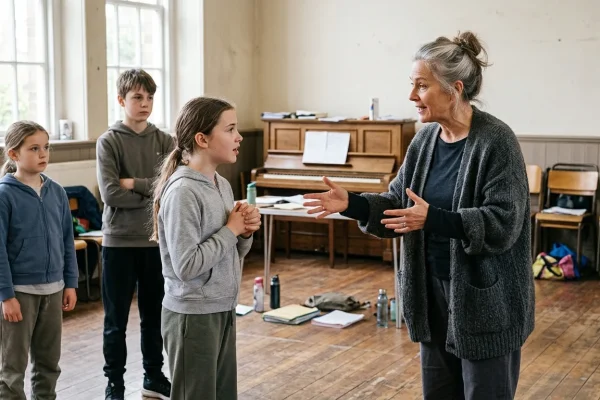
- Facilitate In-Role Exploration: Invite participants to adopt defined viewpoints to solve the problem collectively. The facilitator frequently enters the drama “in role” at a low status to prompt questions without seizing direct control of the outcome.
- Conduct the Reflective Debrief: Transition out of character completely by stepping out of the physical playing area. Facilitate a guided conversation where children discuss what their characters felt, why disagreements happened, and how those dynamics mirror everyday human interactions.
By concluding every session with reflective dialogue, children transform imaginative play into lasting emotional intelligence that stays with them long after the workshop ends.
✨ Bringing creative drama techniques into schools and homes helps children build true self-confidence that never depends on applause.
💚 Share your experience with us: Have your children or students tried process-led drama, or are you still relying on traditional stage plays?
📱 Pass this guide along to teachers, drama leaders, and community artists looking to refresh their creative arts toolbox.
👇 Leave a comment below with your favourite dramatic games and observational exercises.